

tallerRx
Neuroscience-based insights and solutions for brain development, brought to you by tallerRx.
One of the most frequent concerns voiced by parents and educators as children transition into the early school years is a perceived lack of “social skills.” When a child fails to read the room, socially withdraws, or repeatedly exhibits behavior that is out of sync with their peers, adults often attribute these struggles to an introverted personality, stubbornness, or a lack of empathy.
The traditional approach to this problem has heavily relied on top-down behavioral corrections—directives like, “Share with your friends,” or “Pay attention when the teacher is speaking.” However, from the perspective of cognitive neuroscience, these behavioral lectures rarely address the root of the issue.
Recent neuroscientific research indicates that a child’s delayed social functioning is rarely an emotional deficit or a character flaw; rather, it is a bottleneck in the brain’s high-level data processing and inference systems. In this article, we will analyze the underlying cognitive mechanisms that cause social delays and explore evidence-based, clinical training methods to improve them.
1. The True Nature of Social Interaction: High-Speed Non-Verbal Inference
While society generally defines “good social skills” as an easygoing demeanor, neuroscience defines it as the real-time integration and inference of multi-sensory data.
A standard classroom is a highly complex environment where thousands of non-verbal cues are transmitted every second:
- Visual Cues: A teacher’s furrowed brow, a peer looking away.
- Auditory Cues: A sudden drop in the volume of the room, a shift in vocal tone.
- Contextual Cues: Classmates quietly closing their books.
To navigate this successfully, the brain’s prefrontal cortex must instantaneously gather these fragmented sensory inputs, integrate them, and deduce an actionable conclusion—such as, “The room has gotten quiet, and the teacher looks tense; I need to stop talking.” When a child seems socially oblivious, it is not an act of defiance. It is a clinical indicator that their multi-sensory integration and social reasoning systems are experiencing processing errors.
2. The Processing Bottleneck: Weak Central Coherence (WCC)

Why do some children fail to connect these obvious social dots? A critical concept in cognitive psychology, frequently cited in the context of Autism Spectrum Disorder (ASD) and neurodevelopmental differences, is Weak Central Coherence (WCC).
A neurotypical brain exhibits a strong drive for global processing—prioritizing the overarching context over minor details. For instance, if a peer playfully nudges them, the brain instantly grasps the “context” (friendly play) rather than focusing purely on the physical “fact” (physical impact).
Conversely, children with delayed social-cognitive development often default to local processing. They have a cognitive profile that misses the forest for the trees, fixating intensely on fragmented details rather than the big picture.
- Global Processing (Typical): A parent sighs deeply ➔ The child infers the context (“Mom is exhausted or frustrated”) ➔ The child adjusts their behavior.
- Local Processing (WCC): A parent sighs deeply ➔ The child focuses on the sensory fact (“That sounded like a heavy gust of wind”) ➔ The child continues their unrelated monologue.
Telling a child with WCC to “look at the big picture” is essentially demanding that they use a neurological pathway they have not yet developed. To change the behavior, we must implement bottom-up cognitive training that gradually expands their information processing from the “part” to the “whole.”
3. The Core Mechanism: Gestalt Psychology and Visual Closure
To better understand how the brain synthesizes information, we must look at the Gestalt principle of Visual Closure.
When presented with incomplete visual data, the human brain utilizes past experiences and memory to automatically “fill in” the blanks, perceiving a complete image. We recognize a circle even if the line is dotted, or we know a cat is hiding behind the couch even if we only see its tail.
When this physical mechanism of “visual closure” evolves into a higher-order socio-cognitive function, it becomes Theory of Mind (ToM).
- Seeing the downturned corners of a mouth (partial data) ➔ Inferring sadness (complete emotion).
- Hearing someone trail off mid-sentence (incomplete audio) ➔ Grasping their hesitation or hidden intent (complete message).
Children who struggle socially often lack this cognitive closure. Because their brains do not automatically fill in the unseen or unspoken blanks, they process input strictly literally. This is precisely why they often miss sarcasm, fail to understand metaphors, and take jokes as factual statements.
4. The Solution: Structuring Inference Training
Improving a child’s social capacity requires more than teaching manners; it requires upgrading the brain’s “inference engine.” This means consistently exposing the child to incomplete data and training them to deduce the correct whole, thereby strengthening synaptic connections.
Core principles for inference training in clinical or home settings include:
- Inferring the Whole from Parts: Presenting only a tiny fragment of an object or scenario and asking the child to deduce what it is.
- Contextual Outcome Prediction: Pausing an interactive story or video midway and asking the child to predict the character’s next facial expression or action.
- Decoding Obscured Scenarios: Using blurred or partially covered visual materials and prompting the child to explain the underlying situation.
Through this process, the working memory engages with the prefrontal cortex, fiercely cross-referencing current clues with past experiences. This physical strengthening of neural pathways is how “social intuition” is actually built.
5. The Digital Therapeutics (DTx) Intervention: tallerRx
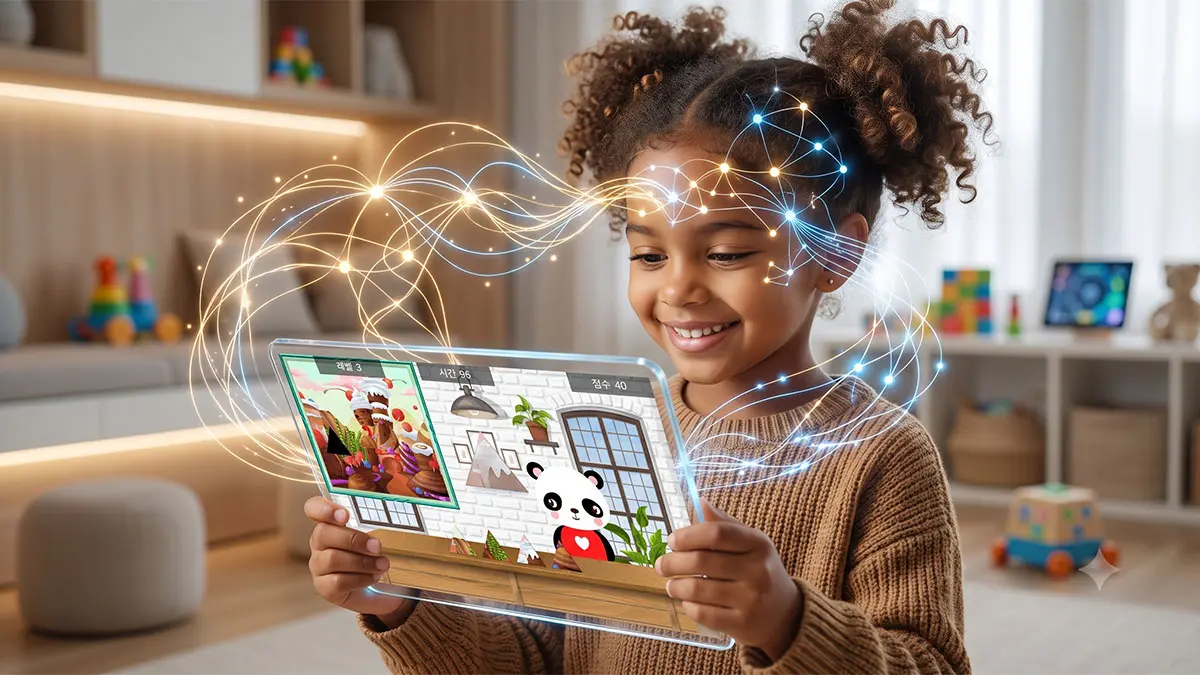
While the theory is sound, manually sourcing obscured images, dynamically adjusting difficulty levels, and maintaining a child’s motivation at home or in traditional therapy is highly impractical. Analog methods often lead to fatigue before true neuroplasticity can occur.
This clinical gap is where tallerRx, our Digital Therapeutics (DTx) platform, excels. Specifically, our cognitive training module, “The Quirky Food Cart,” is engineered to maximize visual closure and social inference through targeted gamification.
[The Cognitive Mechanisms of ‘The Quirky Food Cart’]
- Limited Cue Exposure (Incomplete Data): The system displays only a fragmented visual clue (e.g., a shadow or a small piece) of what an animal customer has ordered.
- Rapid Contextual Inference (Visual Closure): The child must process the fragment in a split second, access their working memory, and infer the complete target object.
- Immediate Social Reward (Dopamine Loop): Correct inferences trigger an immediate, positive non-verbal reaction from the character. This engages the brain’s reward centers, reinforcing the learning loop and ensuring sustained compliance.
While it plays like an engaging arcade game, the underlying software is a rigorous, clinically backed algorithm driving the exact socio-cognitive loop needed: [Cue Detection ➔ Data Integration ➔ Contextual Inference ➔ Appropriate Response]. Furthermore, adaptive learning technology adjusts the difficulty in real-time based on the child’s performance data.
Conclusion: A Paradigm Shift from Behavioral Control to Cognitive Enhancement
The elementary school years represent a critical period of neuroplasticity, where a child’s brain is rapidly refining how it processes the social world. Categorizing a child’s social delays as a personality flaw or a behavioral choice only delays meaningful intervention.
Socialization is a high-level cognitive function. Children who struggle to adapt do not need reprimands; they need structured, scientific training that teaches their brains how to perceive and synthesize the world in its complete form.
By combining professional guidance with validated Digital Therapeutics like tallerRx, we can help children bridge these cognitive gaps. The future of developmental support lies not in demanding better behavior, but in building stronger neurological foundations.

Unlock Your Child’s True Cognitive Potential Today!
Personalized, neuroscience-backed brain training. Just 30 minutes a day.
Start Your 7-Day Free Trial Now